MIDI BREATH CONTROLLER GUIDE
A PRACTICAL HISTORY OF THE MIDI BREATH CONTROLLER.
Electronic wind instruments and keyboard breath accessories developed along related paths. This guide follows Nyle Steiner’s EVI/EWI work, Yamaha’s BC controllers and later MIDI workflows, then separates those milestones from MRTAUDIO’s own product record.
AT A GLANCE
THE IDEA HAS STAYED CONSISTENT: USE BREATH TO SHAPE SOUND CONTINUOUSLY.
A breath controller does not normally create sound. It measures pressure and sends control information to a compatible instrument or software environment. The receiving system decides whether that information changes expression, modulation, volume, timbre or another assigned destination.
Breath controller
A pressure-sensing control source used alongside a keyboard or another instrument.
Wind controller
A playable electronic instrument that commonly combines breath sensing with keys, fingering or note generation.
MIDI destination
The parameter or message the receiving instrument is configured to respond to, such as CC2 or CC11.
SENSOR, MESSAGE, CONNECTION: THREE DIFFERENT THINGS.
A breath headset, a MIDI message and a USB connector are not interchangeable. A compatible interface converts a headset’s sensor signal into MIDI. CC2 is named Breath Controller and CC11 is Expression, but the receiving instrument decides what those messages change. A USB-C socket alone does not establish USB-MIDI host support.
MIDI Control Change referenceThe MIDI Association documents the public connection between a Sequential Prophet-600 and a Roland Jupiter-6 at the January 1983 NAMM show. This was a milestone for communication between instruments, not the invention of breath sensing.
Read the MIDI Association’s history01 · NYLE STEINER, EVI AND EWI
ANOTHER WAY TO PLAY THE SYNTHESIZER.
Nyle Steiner brought a trumpeter’s approach to electronic instrument design. His official archive traces the idea to the 1960s, prototypes to the early 1970s and the playable Steiner Horn/EVI to 1975. Steiner-Parker produced the instruments in Salt Lake City.
Crumar marketed the EVI around the turn of the 1980s; Steiner received the Linz prize in 1980. The later woodwind-style EWI also reached performers such as Michael Brecker. Akai released the EVI1000 and EWI1000 with the EWV2000 module in 1987.
EVI/EWI instruments combine breath with fingering to select notes and control expression; not every model generates audio internally. Steiner’s MIDI EVI requires an external sound source. MRTAUDIO Standard adds breath control alongside a keyboard: the keyboard supplies the notes, and the configured MIDI layers shape the receiving sound.
Read the MIDI EVI manual02 · YAMAHA BC1, BC2 AND BC3
A RECOGNISABLE PRODUCT LINE EMERGED IN THE 1980s.
Yamaha’s official history places the BC1 in the early 1980s as an option for the CS01 synthesizer. The later BC2 adopted a headset form that left both hands free, while the BC3 generation increased sensitivity for more expressive instruments such as the VL1 and VP1. These products helped establish the headset-style breath controller as a practical performance interface.
Primary source: Yamaha Synth 50th Anniversary archive03 · MIDI MADE THE DESTINATION CONFIGURABLE
THE BREATH SIGNAL BECAME PART OF A WIDER CONTROL LANGUAGE.
MIDI allowed breath-derived control to be routed beyond one dedicated synthesizer input. A receiving patch may expect Breath Controller (CC2), Expression (CC11), modulation or another supported message. This flexibility is useful, but the assignment must match the instrument: the same data can produce very different musical results depending on the destination.
Compare CC2 and CC1104 · FROM DIN MIDI TO USB-MIDI
MODERN SYSTEMS CONNECT SOFTWARE AND HARDWARE WORKFLOWS.
Contemporary controllers may send class-compliant USB-MIDI to a supported host and hardware MIDI to a keyboard or sound module. USB simplifies many computer-based setups, while a dedicated MIDI output remains useful when a computer should not sit in the live signal path. Host support, cable type and the receiving instrument’s MIDI implementation still matter.
Read the USB-MIDI connection guide05 · MRTAUDIO DEVELOPMENT RECORD
PRODUCT DEVELOPMENT SINCE 2011.
The following dates describe MRTAUDIO’s own product history and are based on company development, direct-sales and distributor records. They are not presented as a complete history of every breath controller made by the wider industry.
- 2011MRTAUDIO V1
The first MRTAUDIO breath controller generation entered practical use with hardware MIDI workflows.
- 2013–2014V2 development
Testing and code-development assistance from flutist, studio musician and engineer Al Jewer contributed to the work that became V2.
- 2019V3 and ribbon control
The V3 generation expanded the product concept with an additional ribbon-control interface.
- CurrentMRTAUDIO Standard
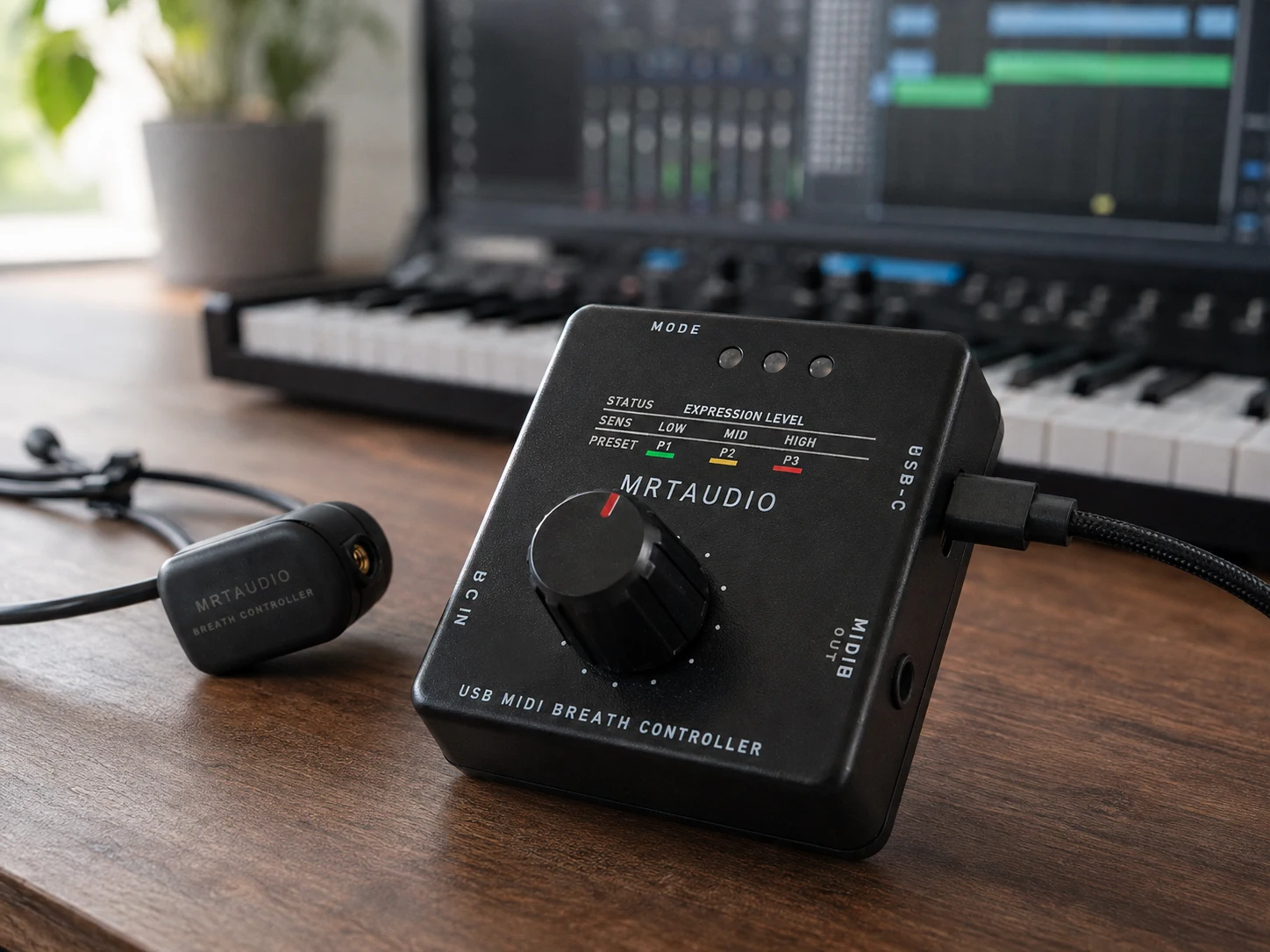
The Standard model combines a headset input, configurable three-layer breath routing, USB-MIDI, hardware MIDI output and browser-based setup.
- DevelopmentTouch Expression
Touch Expression extends the same expressive-control direction with a configurable touch surface and performance banks.
MRTAUDIO records indicate more than 10,000 controllers delivered across earlier and current generations to musicians worldwide. This cumulative figure includes direct and distributor sales.
06 · WHAT HAS CHANGED, AND WHAT HAS NOT
THE CONNECTIONS EVOLVED. THE MUSICAL PURPOSE REMAINED.
Modern calibration, response curves, layered routing and device memory provide more control over how breath is translated. The central task is still straightforward: make continuous musical movement available while the player’s hands remain on the instrument.
SOURCES AND FURTHER READING
Historical statements above use manufacturer material and specialist reference material. MRTAUDIO product dates and delivery figures come from company records.
- Yamaha Synth 50th Anniversary: Breath Controller
- Patchman Music Wind Controller FAQ
- The MIDI Association: MIDI Begins, 1981–1983
- The MIDI Association: MIDI 1.0 Control Change Messages
- Nyle Steiner official homepage, maintained with his cooperation by Patchman Music
- Steiner MIDI EVI Owner’s Manual — Nyle Steiner / Matt Traum